When You Feel Like Your Part Doesn’t Matter

It is easy to look at what needs to be done in the world, in the church, or even in your own family and feel overwhelmed.
The needs are too large.
The problems are too complicated.
Other people seem more gifted, more experienced, or more important.
And sometimes the result is that we do nothing because we are convinced that what we can contribute will not make much difference.
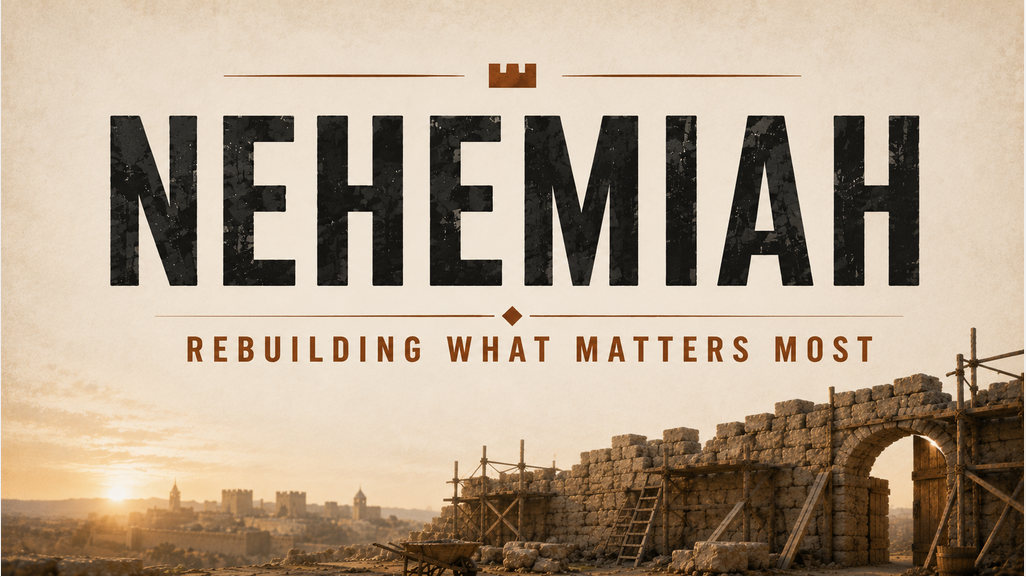
Nehemiah 3 gives us a different picture.
After Nehemiah challenged the people of Jerusalem to rebuild their broken wall, the work did not fall to one extraordinary leader. Instead, the chapter records name after name of ordinary people who took responsibility for part of the work.
There were priests and rulers. There were goldsmiths and perfumers. There were families, merchants, Levites, people from Jerusalem, and people who came from surrounding towns.
They were not all builders by profession.
They did not all have the same abilities.
They did not all work in the same place.
But they all had a part.
That gives us an important principle for our own lives:
God does not ask everyone to do everything, but He does call each of us to be faithful with what He has placed in our hands.
Your Part May Look Different From Someone Else’s
One of the clearest lessons in Nehemiah 3 is that meaningful service does not always look the same.
In the church, it is easy to think that the most important people are the ones who are most visible.
The preacher.
The musician.
The teacher.
The person leading a ministry.
But the New Testament gives us a different picture. Romans 12 says that the body has many members, and those members do not all have the same function. First Peter 4:10 tells believers to use whatever gift they have received to serve others as stewards of God’s “varied grace.”
That word matters: varied.
God does not give everyone the same personality, experiences, abilities, opportunities, or responsibilities.
Some people teach.
Some encourage.
Some organize.
Some pray.
Some cook, clean, repair, give, visit, listen, care for others, or quietly notice a need before anyone else does.
And our place may change during different seasons of life.
There may be things you once could do that you cannot do today. That does not mean you no longer matter.
The better question is not, “Why can’t I do what someone else does?”
It is:
What has God entrusted to me right now?
We Were Never Meant to Work Alone
Nehemiah 3 repeatedly uses phrases such as “next to him,” “next to them,” and “after him.”
One person’s section connected to someone else’s.
Everybody had a section, but nobody had a wall of his own.
That is also true of the church.
Our ministries are not separate little kingdoms. We are part of one body, serving one Lord and participating in one mission.
And that mission is larger than any single congregation.
We should care about the health and growth of our local church, but the ultimate goal is not to make our own name bigger.
The goal is to make Christ known.
Sometimes faithful ministry may strengthen another believer, another congregation, a missionary across the world, or someone in the community who never becomes part of our church.
That is still kingdom work.
Sometimes the Work Is Right in Front of You
Several people in Nehemiah 3 repaired sections of the wall near their own homes.
The text does not explain exactly why those assignments were made, but there is a simple lesson there for us.
Sometimes we spend so much time wondering what great thing God might want us to do someday that we overlook the good He has already placed in front of us.
Your family.
Your neighbor.
A coworker.
Someone at church who is struggling.
A person who needs encouragement.
A practical need you are able to meet.
You may not be able to solve every problem.
You are not supposed to.
But you can be faithful with the opportunities already around you.
Faithfulness Matters More Than Visibility
Most of the people named in Nehemiah 3 are not famous anywhere else in Scripture.
They did not become kings or prophets.
They are remembered because, when the work needed to be done, they were there.
We may not even be able to identify with certainty the exact stones they placed in Jerusalem’s wall.
But their names remain.
Hebrews 6:10 reminds us that God does not overlook the work and love shown in serving His people.
Many acts of faithfulness will never receive public recognition.
A prayer offered.
A meal delivered.
A child taught.
A grieving person encouraged.
A responsibility carried.
A quiet act of kindness.
But God sees them.
And when God works through the faithful obedience of His people, small acts become part of something much larger than any one of us can see.
So perhaps the question to carry with you this week is not:
“Am I doing as much as someone else?”
Instead, ask:
What good has God placed in front of me today?
Then do it faithfully, and trust Him with what He builds from it.
About
-
Hilltop Chapel
-
Family Life Center