When the Crisis Is Over, What Comes Next?

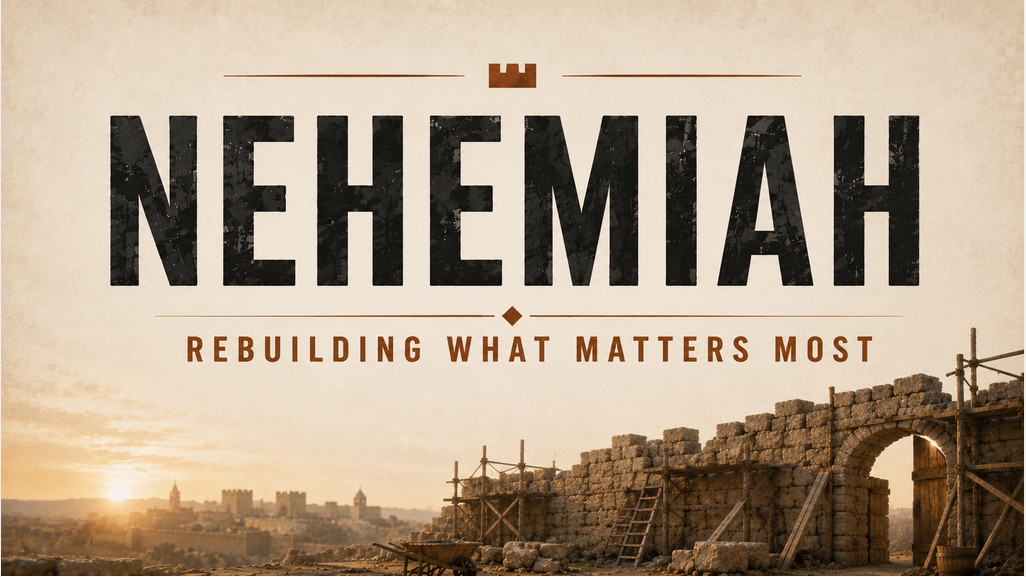
Getting through a difficult season is not the same as being finished. After something broken begins to heal, a new kind of responsibility begins: faithfully caring for what has been restored. Nehemiah 7 shows that God cares not only about what gets rebuilt, but about the people we become afterward.
Most of us know what it is like to focus intensely on a problem.
A relationship is struggling. Our spiritual life has grown cold. Our family is going through a difficult season. Something at work or church desperately needs attention.
We pray. We work. We make changes. And eventually things begin to improve.
Then comes a danger we do not always expect: once the crisis is over, we can become careless again.
That is where Nehemiah 7 begins.
For months, Nehemiah and the people of Jerusalem had been focused on rebuilding the city's broken wall. Finally, the work was completed. But Nehemiah did not say, “We're done.”
Instead, he put safeguards in place. Gates had to be watched. Responsibilities had to be assigned. What had been rebuilt now had to be faithfully cared for. Pasted markdown
It is a principle that reaches far beyond an ancient city: We should not become careless with something we once prayed earnestly for God to restore.
If God has renewed your desire to know Him, keep feeding it. If a damaged relationship has begun to heal, keep tending it. If your family has established healthier patterns, keep practicing them.
Restoration requires stewardship.
Faithfulness Usually Looks Ordinary
Nehemiah then entrusted Jerusalem's responsibility to two men, Hanani and Hananiah. What stands out about Hananiah is not simply his position. Nehemiah says he was “a more faithful and God-fearing man than many” (Nehemiah 7:2).
Faithfulness is rarely dramatic.
It looks like:
- Showing up
- Keeping your word
- Doing the job well when nobody notices
- Caring for the people and responsibilities already in your life.
Jesus expressed the same principle in Matthew 25:21: “You have been faithful over a little; I will set you over much.”
Sometimes we wonder what greater thing God might want us to do someday. A better question may be: Am I being faithful with what He has already placed in my hands?
For Christians, that faithfulness is not a way to earn God's love. We begin with grace. Through Jesus Christ, God brings us into relationship with Himself, and His grace begins changing the way we live. Faithfulness becomes our response to what He has already given.
We Are Part of a Story Bigger Than Ourselves
Much of Nehemiah 7 is a long genealogy. At first glance, it is the kind of passage we are tempted to skim.
But those names reminded Nehemiah's generation of something important: Their story did not begin with them.
Other people had returned from exile before them. They had rebuilt the temple, restored worship, endured opposition, and passed something on to the next generation.
The same is true for us.
Someone may have taught us the Bible, prayed for us, told us about Jesus, supported a church, or quietly modeled faithfulness through difficult years.
We cannot inherit another person's relationship with God. Every person must personally respond to Christ. But we can receive a spiritual heritage, and then we face an important question: What are we handing to the people who come after us?
Psalm 78:4 says, “We will not hide them from their children, but tell to the coming generation the glorious deeds of the LORD.”
We may never know how far today's faithfulness will reach. A prayer, a conversation with a child, an act of service, or years of steady obedience may become part of something God carries far beyond our lifetime.
Nehemiah 7 reminds us that finishing the visible project is not the end.
God is still building people.
And perhaps one of the best prayers we can carry into this week is simply: Lord, find us faithful with what You have placed in our hands.
Read and Reflect
Read: Nehemiah 7:1–5, Matthew 25:14–23, and Psalm 78:1–7.
- What responsibilities began after Jerusalem's wall was completed?
- What does Nehemiah 7:2 tell you about the kind of character Nehemiah trusted?
- Is there something God has helped restore in your life that now needs continued care?
- What faith or spiritual heritage have others handed to you?
- What are you intentionally passing on to the people who come behind you?

About
-
Hilltop Chapel
-
Family Life Center