Before You Act: How to Face Problems with Wisdom and Hope

Most of us know what it feels like to see a problem and immediately want to do something about it.
- A relationship is strained.
- Something at work is not functioning well.
- We hear troubling information about someone.
- We recognize a weakness in our own lives.
- Maybe we see a need in our church or community.
Our instinct can be: Fix it. Say something. Make a decision. Get moving.
But sometimes the faithful next step is not immediate action. Sometimes it is careful understanding.
Nehemiah learned that when he arrived in Jerusalem.
He already knew the city walls were broken and the gates had been burned. He had prayed about the situation for months and traveled hundreds of miles to help. Yet when he arrived, he did not immediately announce a plan.
Instead, Nehemiah quietly went out at night with a few men and inspected the damage for himself.
That gives us an important principle:
Before we can faithfully address a problem, we must examine it honestly.
 Discretion: Knowing When to Speak and When to Wait
Nehemiah 2:12 says that he had not yet told anyone what God had put into his heart to do for Jerusalem.
That was not secrecy or dishonesty. It was discretion.
Discretion is the wisdom to know what should be said, when it should be said, and who needs to hear it.
That quality seems increasingly rare.
We hear part of a story and immediately form an opinion.
Someone tells us something privately, and before long we have “shared it as a prayer request.”
We hear about conflict and decide who is right before hearing both sides.
We notice something wrong and announce a solution before understanding the problem.
Social media makes this even easier. We can react instantly to information we barely understand.
The Bible gives a better way.
Proverbs 18:13 says: “If one gives an answer before he hears, it is his folly and shame.”
Discretion means we slow down enough to listen.
- It means that when someone trusts us with something confidential, we protect that trust unless there is a compelling moral or safety reason it must be shared.
- It means we do not repeat information simply because we know it.
- It means we distinguish between what is true and what is ours to tell.
- It means we ask questions before drawing conclusions.
And sometimes it means admitting, “I do not know enough yet.”
Discretion is not weakness. It is wisdom under control.
Nehemiah already knew God had placed Jerusalem on his heart. His inspection was not about deciding whether he would obey God. It was about understanding what obedience would actually require.
Jesus used a similar principle when He spoke about counting the cost before building a tower. Faith does not require careless action. Wise people look carefully before they leap.
Honest Assessment Is Only Half the Story
When Nehemiah inspected Jerusalem, the reality was worse than a few missing stones. At one point the rubble was so severe that his animal could not get through.
He did not minimize what he saw.
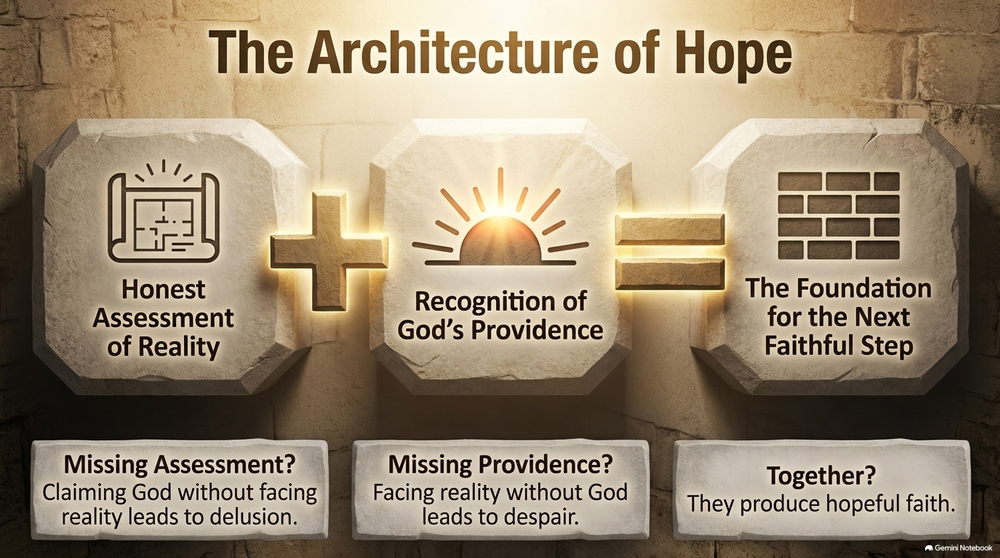
That matters because hope is not pretending everything is fine.
But honest assessment by itself can become discouraging. If all we do is study what is wrong, eventually the ruins become the only thing we see.
That is where the second part of what I call the architecture of hope becomes important.
Nehemiah gathered the people and said: “You see the trouble we are in.”
He told the truth.
Then he told them something else: “I told them of the hand of my God that had been upon me for good.”
He told them what God had done:
- The king of Persia had opened the door for Nehemiah to come.
- Resources had been provided.
- Circumstances Nehemiah could not control had changed.
Nehemiah called that the good hand of God.
So he gave the people both realities:
- Here is what is broken. And,
- Here is how God has already been at work.
That is biblical hope.
Biblical honesty does not hide the ruins, but biblical hope does not leave us staring at them.
Tell People What God Has Done
Nehemiah's testimony had an impact.
After hearing what God had done, the people said: “Let us rise up and build.”
Then Scripture says: “They strengthened their hands for the good work.”
That expression means they took courage. Their resolve was strengthened. They became ready to act.
There is something powerful here: God's good hand upon Nehemiah became part of what strengthened their hands for the good work.
Our stories can affect people too.
- A good testimony is not about making ourselves impressive. It is simply telling the truth about what God has done.
- A good testimony is honest. We do not exaggerate.
- It is specific. Instead of only saying, “God is good,” we explain where we saw His goodness.
- It is humble. God remains the focus.
- And it is relevant. We share enough of our story to help someone else.
Even someone who does not share our faith may listen differently to a personal story than to an argument. They may not agree with everything we believe, but they can hear how faith gave us hope, changed a decision, sustained us through difficulty, or transformed our lives.
For another Christian, testimony can strengthen faith. Sometimes we need someone else to remind us:
- “God answered prayer.”
- “God provided.”
- “God was faithful.”
- “God helped me through this.”
And the greatest testimony Christians have is not that every circumstance worked out the way we wanted. It is that God has shown His grace to us through Jesus Christ. Through Him we can be forgiven, changed, and given new life and hope.
Take the Next Faithful Step
The graphic above summarizes it well: Honest assessment of reality + recognition of God's providence = a foundation for the next faithful step.
- If we talk about God while refusing to face reality, we can drift into denial.
- If we face reality without remembering God, we can drift into despair.
- But when we honestly understand what is before us and remember the faithfulness of God, hope gives us courage to move forward.
You may not know how to solve everything today.
You may not need to.
Start here:
- Look carefully.
- Listen wisely.
- Remember what God has done.
- Then take the next faithful step.

About
-
Hilltop Chapel
-
Family Life Center